TerMus BRIDGE — Professional Thermal Bridge Software
Calculate Every Thermal Bridge. For Any Construction Detail. With FEM Precision.
TerMus BRIDGE is the professional thermal bridge software that uses finite element analysis to simulate and calculate thermal bridges and Psi-values for any construction detail — any material composition, any geometry, any shape. Fully compliant with EN ISO 10211:2017, EN ISO 14683:2008, and EN ISO 13788:2013. Free to try. Supported by Isotech across the GCC and MEA.
Trust Statement Before technology, there has to be a relationship. ACCA software and Isotech work alongside energy engineers, building physicists, and sustainability consultants across the Middle East — coaching and supporting your adoption of professional thermal bridge analysis tools from day one.
Value Pillars
Thermal Bridge Finite Element Analysis. High-Performance FEM Solver Built In.
TerMus BRIDGE uses an integrated FEM solver — TheBriNA — for 2D thermal bridge simulation. No third-party solver. No external engine. Professional-grade thermal bridge finite element analysis from within the same application where you define the construction detail.
Psi-Value Calculator for Any Construction Detail
Calculate linear thermal transmittance — Psi-values (Ψ) — for any thermal bridge configuration: wall-floor junctions, window reveals, balcony connections, roof edges, structural penetrations, and more. Any shape. Any material combination.
ISO 10211 Software. Fully Standards-Compliant.
TerMus BRIDGE is ISO 10211 software compliant with EN ISO 10211:2017 for numerical methods, EN ISO 14683:2008 for linear thermal bridges, and EN ISO 13788:2013 for hygrothermal assessment. Compliance documentation for authority submission included.
Thermal Bridge BIM. Integrated with TerMus PLUS.
Live integration with TerMus PLUS, ACCA's dynamic energy analysis software — materials data defined in TerMus PLUS transfers directly into TerMus BRIDGE. Thermal bridge BIM workflow connecting construction detail analysis to the full building energy model.
Isotech Support from Day One
Isotech coaches and supports energy engineering teams across the GCC from initial configuration through long-term workflow integration. Before technology, there has to be a relationship.
Why Thermal Bridge Analysis Matters in the GCC
Thermal Bridges Are Not a Cold Climate Problem. They Are a Building Physics Problem.
There is a common assumption that thermal bridge analysis is primarily relevant to cold climate construction — where thermal bridges drive heat loss and condensation risk in winter. In GCC buildings, the reality is more complex and the consequences more significant than this assumption suggests.
In extreme hot climates, thermal bridges at structural connections, window reveals, and roof-wall junctions create localised high-temperature zones on interior surfaces — driving cooling load increases, surface condensation risk in humid coastal environments, and potential mould growth at construction junctions where insulation is compromised.
For buildings required to meet Estidama Pearl Rating criteria, UAE Green Building Regulations, LEED energy prerequisites, or Saudi Building Code energy performance standards, accurate thermal bridge calculation is increasingly part of the compliance evidence trail — not an optional refinement.
TerMus BRIDGE is the thermal bridge software that provides the rigorous, standard-compliant analysis that these compliance frameworks demand — with an integrated FEM solver, graphical input tools, and comprehensive calculation reports for every construction detail that requires it.
Core Capabilities
Complete Thermal Bridge Analysis — From Construction Detail Definition to Authority Submission.
TerMus BRIDGE uses an innovative graphical input system to define thermal bridge cross-sections — using visual objects that carry all the material and boundary condition data required for numerical calculation. Zoom, snap, and radial or rectangular grid tools provide drawing precision for complex construction details.
Construction details can be built from scratch using the graphical input, or imported directly from DXF and DWG CAD files — tracing over the architectural or construction detail drawing to reproduce the actual geometry of the junction being analysed.
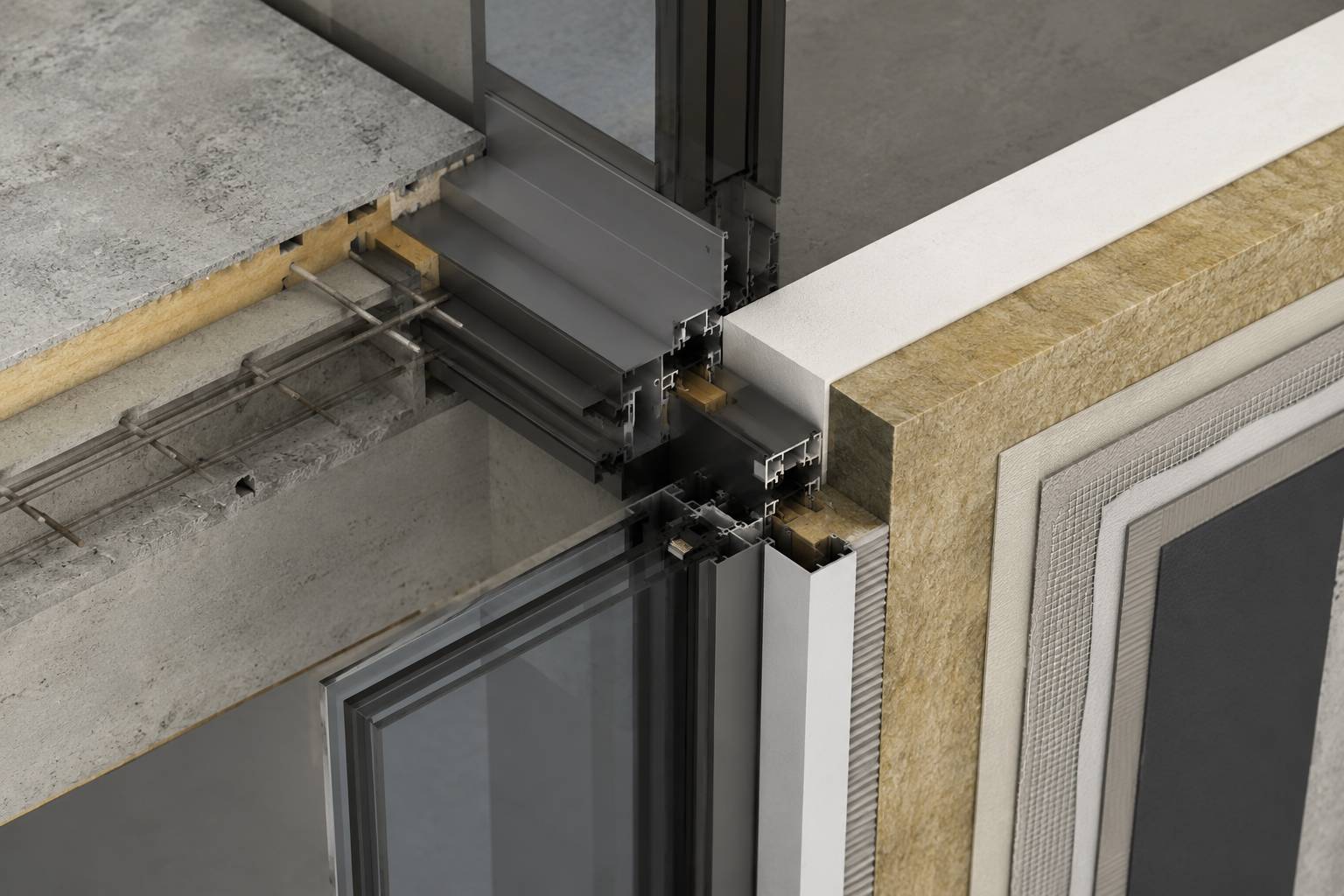
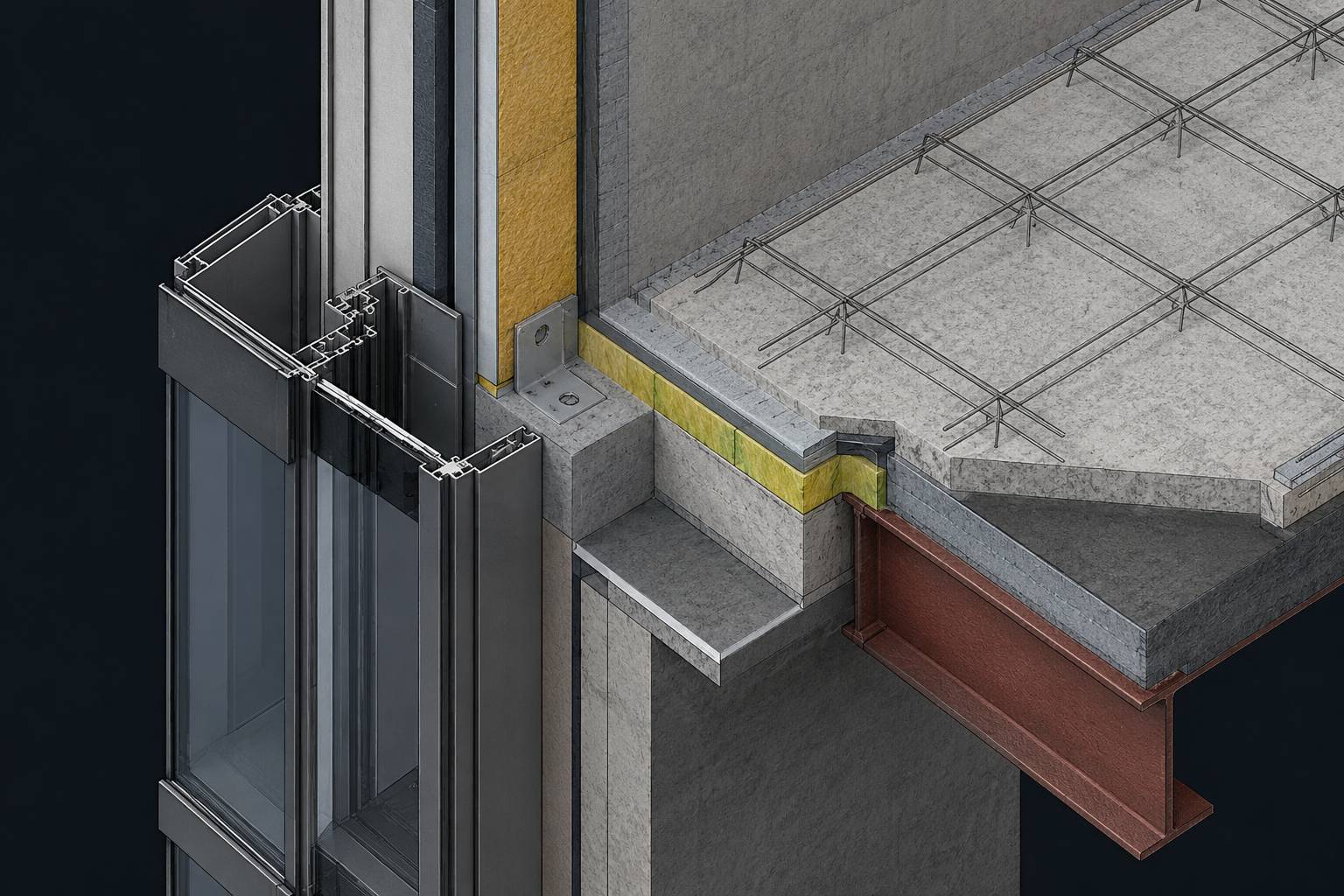
Any shape, any material composition, any construction system. TerMus BRIDGE thermal bridge analysis handles every construction detail from simple wall-floor junctions to complex structural connections with multiple material layers, embedded elements, and non-rectangular geometries.
The simulation core of TerMus BRIDGE is the TheBriNA integrated finite element solver — purpose-built for 2D thermal bridge finite element analysis in compliance with the numerical requirements of EN ISO 10211:2017.
Once the construction detail is defined, TheBriNA discretises the cross-section into a finite element mesh, assigns thermal conductivity values to each element from the material database, applies the boundary conditions, and solves the resulting heat transfer equations to produce the full temperature field, heat flux distribution, and Psi-value for the defined junction.
The FEM calculation produces results of the precision and rigour that ISO 10211 software compliance requires.
The primary output of every thermal bridge calculation in TerMus BRIDGE is the linear thermal transmittance coefficient — the Psi-value (Ψ) — which quantifies the additional heat flow through the thermal bridge beyond what would occur through the uniform portions of the surrounding envelope elements.
TerMus BRIDGE calculates Psi-values for any junction configuration and any material specification — providing the PSI value calculator capability that energy engineers and building physicists need.
Thermal bridges reduce surface temperatures at construction junctions. Where surface temperatures fall below the dew point of interior air, condensation occurs — and where condensation is sustained, mould growth follows.
TerMus BRIDGE includes mould growth risk assessment in accordance with EN ISO 13788:2013 — calculating minimum surface temperatures at the analysed junction and evaluating the risk of condensation and mould growth under the defined boundary conditions.
TerMus BRIDGE produces complete thermal bridge calculation reports in both numerical and graphical form — covering construction detail geometry, material properties, boundary conditions, finite element mesh, temperature distribution maps, heat flux diagrams, Psi-value results, surface temperature factors, and mould growth risk assessment where applicable.
Reports are formatted for professional submission to building authorities, energy performance assessors, and green building rating bodies.
Thermal Bridge BIM Integration
Thermal Bridge BIM. Live Integration with TerMus PLUS.
TerMus BRIDGE is integrated with TerMus PLUS — ACCA's dynamic energy analysis and simulation software — through a live data connection that links the construction detail analysis in TerMus BRIDGE to the full building energy model in TerMus PLUS.
Materials defined and characterised in TerMus PLUS are available directly in TerMus BRIDGE — eliminating the re-entry of material data and ensuring consistency between the envelope assemblies used in the energy model and the construction details analysed for thermal bridging. Psi-values calculated in TerMus BRIDGE feed directly into the thermal bridge correction factors applied in TerMus PLUS's dynamic energy simulation — creating a complete, connected thermal bridge BIM workflow from construction detail to building energy performance.
For energy engineers running both dynamic energy analysis and detailed thermal bridge calculation on the same project, this integration means both tools work from the same material database and the same project context — reducing setup time, eliminating inconsistency risk, and ensuring that the thermal bridge analysis and the energy model reflect the same construction specification throughout.
TerMus BRIDGE also accepts IFC model import — allowing building geometry and element properties from BIM models to inform the construction detail analysis, and supporting thermal bridge BIM workflows on projects using openBIM coordination through the usBIM platform.
What Our Testimonials Say

Marcin Pszczolka
Poland • Civil Design Lead
Pierpaolo Canini
SwitzerlandVictor Fuentes
Chile
David Quevedo
Ecuador
Marcin Pszczolka
Poland • Civil Design Lead
Pierpaolo Canini
SwitzerlandVictor Fuentes
Chile
David Quevedo
EcuadorTechnology Partner
We are proud to partner with ACCA Software, a global provider of BIM, digital construction, and Common Data Environment (CDE) solutions. Through this collaboration, we leverage advanced technologies that support ISO 19650-compliant workflows, streamline project coordination, and enhance information management across the entire project lifecycle.
This partnership enables us to deliver innovative, scalable, and industry-aligned solutions that help clients improve collaboration, efficiency, and project outcomes.
Questions Worth Answering Up Front.
What is thermal bridge software and what does TerMus BRIDGE calculate?
Thermal bridge software is a specialised building physics tool for analysing heat transfer at construction junctions where the continuity of the thermal envelope is interrupted — by structural elements, window frames, balcony connections, roof edges, or any other detail where the insulation layer is breached or reduced. TerMus BRIDGE performs this analysis using 2D finite element simulation, calculating the temperature field across the junction cross-section and deriving the linear thermal transmittance — the Psi-value — that quantifies the additional heat flow through the thermal bridge.
Beyond the Psi-value, TerMus BRIDGE also calculates surface temperature factors for mould growth risk assessment under EN ISO 13788:2013 — identifying whether condensation conditions are likely to occur at the junction under the defined boundary conditions. Full calculation reports are produced for every analysis, formatted for professional submission to building authorities and green building rating assessors.
Why is thermal bridge analysis relevant to buildings in the GCC?
Thermal bridge analysis is commonly associated with cold climate construction, but it is equally important — and in some respects more complex — in hot climate building environments. In GCC buildings, thermal bridges at structural connections and window junctions create two distinct problems.
First, additional heat gain through thermal bridge locations increases the cooling load of the building — worsening energy performance beyond what the uniform envelope U-values suggest. For buildings required to demonstrate energy compliance under UAE Green Building Regulations, Estidama, or LEED, unaccounted thermal bridge effects can cause a compliance failure that would not be apparent from a simplified energy calculation.
Second, in humid coastal GCC environments — Abu Dhabi, Dubai, Jeddah, coastal Qatar — where interior spaces are heavily air-conditioned and exterior humidity levels are high, thermal bridges that reduce interior surface temperatures can create condensation conditions and mould growth risk at construction junctions. EN ISO 13788 mould risk assessment, performed within TerMus BRIDGE, quantifies this risk and demonstrates compliance with hygrothermal performance requirements.
What is a Psi-value and how does TerMus BRIDGE calculate it?
The Psi-value (Ψ) is the linear thermal transmittance coefficient — a measure of the additional heat flow per metre length of a thermal bridge junction, beyond the heat flow that would occur through the uniform portions of the surrounding envelope elements. It is expressed in W/(m·K) and is the key parameter for integrating thermal bridge effects into building energy calculations and compliance submissions.
TerMus BRIDGE calculates Psi-values using the TheBriNA integrated finite element solver, compliant with EN ISO 10211:2017. The construction junction cross-section is drawn using the graphical input tools or imported from DXF/DWG CAD files. Material thermal conductivity values are assigned from the material database. Boundary conditions are defined. The FEM solver discretises the section into a finite element mesh and solves the heat transfer equations to produce the temperature field, heat flux distribution, and Psi-value. The entire process — from construction detail definition to Psi-value output — is contained within TerMus BRIDGE, with no external solver or additional software required.
What is ISO 10211 software compliance and why does it matter?
EN ISO 10211 is the European standard specifying the numerical methods for calculating heat flows and surface temperatures at thermal bridges in building construction — defining the calculation procedures, boundary conditions, and validation requirements for thermal bridge finite element analysis. ISO 10211 software compliance means that the FEM calculation methodology implemented in the software meets the technical requirements of the standard, producing results that are acceptable to building authorities and energy performance assessors who specify or accept ISO 10211 calculations.
TerMus BRIDGE is compliant with EN ISO 10211:2017 through its TheBriNA integrated FEM solver — verified against the benchmark cases defined in the standard. For energy consultants and building physicists working on projects where ISO 10211 thermal bridge calculation is a compliance requirement or a green building submission requirement, TerMus BRIDGE provides the ISO 10211 software capability within a practical, guided interface that does not require FEM expertise to operate.
How does the thermal bridge BIM integration between TerMus BRIDGE and TerMus PLUS work?
TerMus BRIDGE and TerMus PLUS are integrated through a live data connection that links the material specifications in the dynamic energy model with the construction detail analysis in the thermal bridge software. When materials are defined and characterised in TerMus PLUS — envelope assemblies, wall constructions, glazing systems — those material properties are available directly in TerMus BRIDGE for use in thermal bridge cross-section analysis. This live connection ensures that the materials used in the thermal bridge calculation are consistent with those used in the dynamic energy simulation — eliminating data re-entry and the risk of inconsistency between the two analyses.
Psi-values calculated in TerMus BRIDGE feed back into TerMus PLUS as the linear thermal transmittance correction factors applied at each junction type — completing the loop between detailed thermal bridge analysis and the full building energy performance model. For energy engineers running both tools on the same project, this thermal bridge BIM integration significantly reduces setup time and ensures that the complete energy performance picture is built from a single, consistent set of material and construction data.
What support does Isotech provide for TerMus BRIDGE?
Isotech provides end-to-end coaching and implementation support for TerMus BRIDGE across the Middle East and Africa — from initial material library configuration for GCC construction systems and pre-defined thermal bridge template setup, through team training for energy engineers and building physicists, to long-term technical assistance and workflow integration with TerMus PLUS. We provide guidance on the specific thermal bridge calculation requirements of the green building compliance frameworks relevant to your projects — Estidama, UAE Green Building Regulations, LEED, and Saudi Building Code energy provisions — and configure your TerMus BRIDGE workflow to produce the calculation output those frameworks require. Contact our team to discuss your specific project requirements.
The Thermal Bridge Software That Gives Every Construction Detail the Analysis It Deserves.
TerMus BRIDGE is the ISO 10211 software that puts rigorous 2D thermal bridge finite element analysis, accurate Psi-value calculation, mould growth risk assessment, and thermal bridge BIM integration into one professional, accessible platform — backed by ACCA’s building physics expertise and Isotech’s regional coaching and support from day one.
Try it free. Calculate with confidence. Build with Isotech alongside you.
“Technology creates possibilities. Relationships create successful outcomes.”